
Page 1
Frondescence Please!
Debbie Teashon
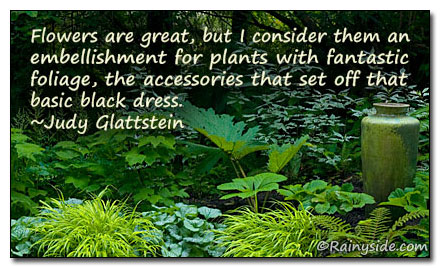
"Flowers are great, but I consider them an embellishment for plants with fantastic foliage, the accessories that set off that basic black dress. ~Judy Glattstein
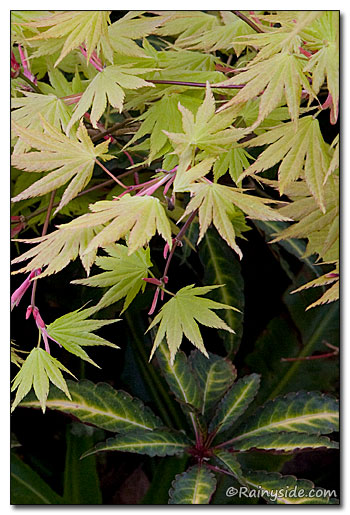
Acer 'Autumn Moon' and Impatiens omeiana
I was cruising through a catalog one morning, enjoying all the flower images inside its covers. Stunning photos of remarkable blossoms help nurseries sell their wares; however, what I wanted to see is the frondescence, and lots of it! Great garden designs include components of fabulous leaf textures as well as flowers.
I love foliage. Almost any leaf that is bumpy or lumpy, brightly hued, or unusual, grabs my attention. It’s hard to miss the Gunneras with their massive Jurassic Park sized leaves, or the brightly hued foliage of the many coral bells (Heucheras) breeders churn out of their tissue culture labs these days. Some leaves look as if an impressionist painter created the artistic patterns and textures. While other foliage, such as the porcupine tomato (Solanum pyracanthum) with its neon orange thorns down the middle of the leaf, look like Picasso had a bit of fun with it. Nature, along with plant breeders, have provided us with a huge palette of foliage textures, sizes, and colors so the creative person can paint their gardens into glorious masterpieces.
Foliage is the mainstay in the garden. Please don’t misunderstand me. I love flowers just as much as the next person does. While blossoms take center stage, the leaves dress the platform. Too many flowers in the garden is too syrupy for my eyes, I need a place to rest them in between the eye candy. That is where beautiful foliage creates balance and harmony, and a place to relax the eyes.
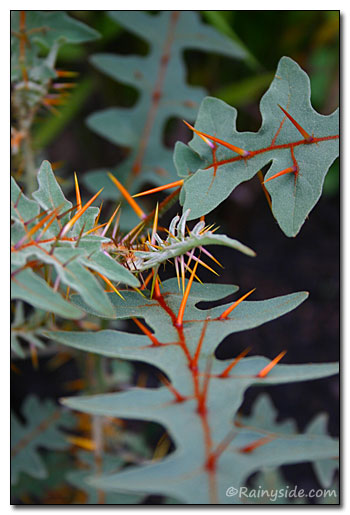
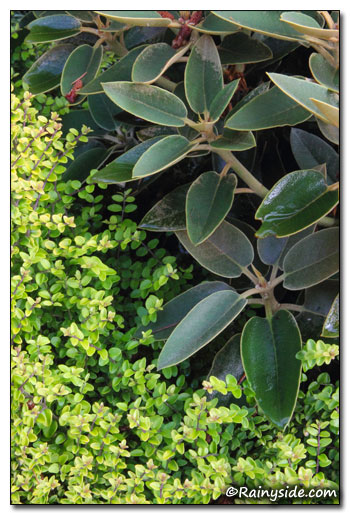
Left photo: Bright orange thorns in the leaves gives the porcupine tomato (Solanum pyracanthum) an unusual look. Photo right: at the feet of the rhododendron is the low growing evergreen honeysuckle shrub—Lonicera 'Twiggy'.
Good Garden Design Includes Foliage
Foliage is an integral part of a good design—most garden designers use them intentionally in their garden projects. With all the diversity of size, color, and form in leaves, a person can give rise to combinations of plants that make any onlooker appreciate the garden canvas in front of them, even when nothing is in bloom!
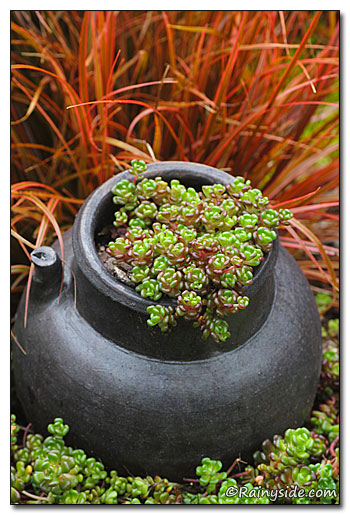
I love growing spike moss (Selaginella) in containers. Last year I planted Selaginella kraussiana 'Aurea' under the rim of a large water bowl in the garden to keep it shaded. Then I planted some hook sedges (Uncinia rubra ‘Belinda’s Find’) in front of it. With no guarantees there would be enough shade for the spike moss, I am always willing to move a plant if my experiment fails to give good results. It worked and even though the spike moss crawled out into the sun, it showed no signs of burnt foliage. Meanwhile, just to the left and in full sun, I planted a small black pot with our native Sedum oreganum ssp. tenue, which has smaller rosettes of leaves than the Oregon sedum (Sedum oreganum). The tiny sedum’s new growth echoes the rusty hues of the hook sedges. More of the same sedums surround the pot, which makes for a lively combination of textures. In addition, this grouping looks great with 4 seasons of color. Until the sedum sends up corymbs of fiercely yellow, tiny blossoms for a short time in summer the foliage will carry the scene the rest of the year.
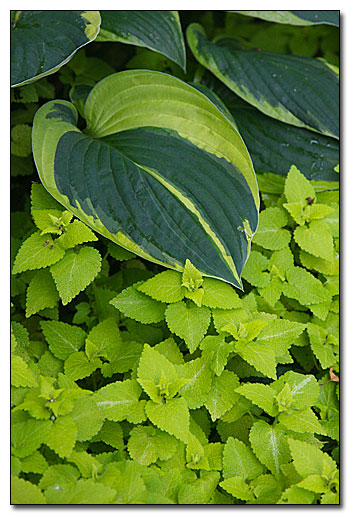
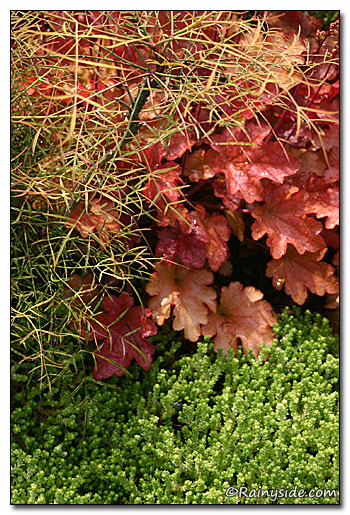
The left photo of Hosta 'Fortunei Aureomarginata' and Lamium 'Aureum' show an outstanding combination of plants, with varying textures and color, with the chartreuse-yellow hue echoed in each other. The right photo shows a flamboyant combination of heavenly bamboo (Nandina domestica 'Filamentosa'), coral bells (Heuchera 'Peach Flambe'), and Sedum acre. Not one flower in either compositions, but just as striking!
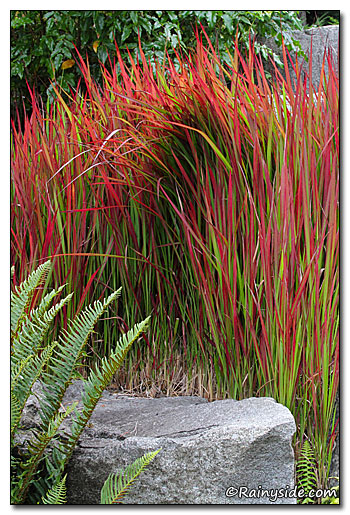
Japanese blood grass (Imperata cylindrica)
Too Much of a Good Thing
I’ve toured a few gardens with too many variegated plants packed together. Moreover, I've planted a few containers where I went overboard with variegation. Ouch! My eyes! I like to call the affliction "variegation build-up." Too many plants with multi-colored foliage, leaves me feeling slightly nauseous. Our eyes need a place to rest from the exuberance of flowers or variegated leaves. I remember one home where a spotted laurel (Aucuba japonica ‘Gold Dust’) grew everywhere. They were foundation plants for the home as well as used as hedging for one side of their yard. Whoever planted them; either received an excellent deal from a nursery, or just liked the plants to the point of obsession. Their bright, mostly acidy-gold with green foliage jolted my eyes whenever I walked down their long driveway. Even now, I dislike this broadleaf evergreen even though I’ve seen single specimens used as understory plants in a shaded garden with calmer splashes of yellow on its leaves. Unfortunately, I can't get past the gaudiness of my first encounter with the shrub.
One of my favorite books, Consider the Leaf: Foliage in Garden Design
If you are too intimidated by trying out foliage combinations on your own, the book
Fine Foliage: Elegant Plant Combinations for Garden and Container
Dare to do something different and leave the flowers out of the design for the moment. If you do add in flowers, be sure to make your plant choices based on good leaf textures, and is harmonious with your other selections. When the flowers fade, your garden will give you a lot of frondescent pleasure!
Here's a Gallery of Foliage Plants to help you create your own fantastic foliage combinations.

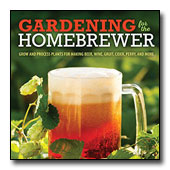
Gardening for the Homebrewer: Grow and Process Plants for Making Beer, Wine, Gruit, Cider, Perry, and More

By co-authors Debbie Teashon (Rainy Side Gardeners) and Wendy Tweton
Copyright Notice | Home | Search | Articles