
Glossary of Gardening Terms
a | b | c | d | e | f | g | h | i | j | k | l | m | n | o | p | q | r | s | t | u | v | w x y z |
| a | |
| abscission layer | A layer of cells at the base of a plant part (like a leaf) that dissintegrates, causing that part to become separated. |
| accuminate | Tapering to a point. |
| acute | Sharp pointed. |
| adventitious |
Arising at an unexpected location. A plant organ, like a root, shoot or bud is produced in an unusual position or during an unusual time. Examples:
|
| annual | A plant that grows from a seed, flowers, sets seed, and dies in one growing season. |
| anther | The part of the stamen that bears the pollen. |
| apetalous | Lacking petals. |
| apex | The tip, pointed end, or growing point of an organ. |
| b | Top of Page |
| biennial | A biennial is a plant that grows from a seed, flowers, sets seed and dies the second year after germinating. |
| bolting | The period of a plant's development when it begins trying to make flowers. This term is usually used when referring to a vegetable plant whose flowers or fruit are not the edible crop, such as lettuce or carrots. As such bolting refers to the end of a plant's usefulness as a crop. |
| bract | A modified leaf that is found in a flower cluster or base of a flower. Many bracts are smaller than the ordinary leaves on the plant but some are very showy surrounding a group of insignificant flowers. Poinsettias and dogwoods are good examples of bracts that look like flower petals but are actually leaves surrounding the actual flowers. |
| bud | An undeveloped leafy shoot or flower. |
| bud scale | A modified leaf that is waxy or corky that protects a dormant bud. |
| c | Top of Page |
| calyx |
The outer set of flower parts. Sometimes they look like leaves and in some plants like petals and occasionally in some they form a tube.
The calyx is what you see before the flower opens and it protects the innermost petals. The calyx is made up of the sepals while the corolla is the petals. Example: The calyx is what you see in a fuchsia flower bud. As it opens you see the corolla made up of the petals. |
| chitting | Soaking the seed and allowing it to start to germinate before sowing. |
| composite head | An inflorescence of many tightly packed small flowers sometimes smaller ones in the center and larger flowers around the perimeter that look like petals. An example of this flower is a daisy or an aster. |
| cotyledon | Hitchcock says, "A leaf of the embryo of a seed". More simply the first leave(s) to appear after the seed germinates and before the true leaves appear. |
| cuticle | The protective layer of cutin covering the epidermis of plants. |
| cutin | A waxlike, water-repellent material present in the walls of some plant cells, and forming the cuticle that covers the epidermis. |
| d | Top of Page |
| deciduous | Falling after the completion of its normal function. Falling off after maturity or at the end of a growing season. A good example is deciduous trees lose all foliage at the end of the the growing season. Not evergreen. |
| decurrent | Running downward beyond the point of junction. |
| dioecious | Male and female flowers are produced on seperate plants. Plants will need both plants for fruit or seeds. Sometimes only one male plant is needed to pollinate several female plants. |
| distichous | Arranged in two, opposite vertical rows. |
| e | Top of Page |
| elliptic | Broadening at the center and narrowing equally toward each end of the leaf. |
| endemic | Endemic plants are species that occur naturally in a restricted area and nowhere else in the world. |
| entire | A leaf that has a smooth margin (edge of leaf) — not toothed or lobed. |
| exfoliating | As in exfoliating bark that peels off in layers. A good example of this can be seen on our native Arbutus menziesii (Pacific Madrone). |
| f | Top of Page |
| fasciate | Banded or compacted together. A good example is the stems of one of my favorite pussy willows, Salix sachalinensis 'Sekka'. It looks like several stems are growing together. |
| fallow | Tilled and left with no plant life for a considerable time. |
| family | The taxonomic rank above the level of genus and below the order. |
| filament | The part of the stamen that acts as a stalk for the anther. |
| g | Top of Page |
| garden origin | The origin of a plant that has been artificially bred, or selected. The plant did not originally occur in the wild. |
| genera | Plural for genus. |
| genus | A taxonomic rank above the level of species and below family. |
| glabrous | Smooth and hairless. To be specific: having an epidermal covering that is totally or relatively free of hairs or indumentum. |
| glaucous | Blue-green or a blue-gray to white powdery bloom which usually refers to the leaves and stems. Green grapes would be described as glaucous also. |
| h | Top of Page |
| harden off, hardening off | A process of gradually acclimating young plants to outdoor conditions. |
| herb | Technically a non-woody plant, but in horticulture an herb often refers to any plant that is culinary or used medicinally. |
| herbaceous | A non-woody plant. |
| heterophyllous (adjective) |
Having leaves of different sizes or shapes or producing different leaves in Winter and Summer. Viola palmata has early and late season leaves that are unlobed, but the midseason leaves are lobed. |
| heterophylly (noun) | More than one type of leaf on a plant, examples are floating leaves and submersed leaves on the same aquatic plant. |
| hip | Fruit of a rose. |
| i | Top of Page |
| indumentum | A hairy covering as on leaves. Can be seen on top and bottom surfaces of young leaves, but its usually confined to the underside of older leaves. |
| indusium | In ferns, a small flap covering the sori, or fruit dots. In flowers, a collection of hairs united to form a cup that encloses the stigma of a flower. |
| inflorescence | An arrangement of flowers on a single main stalk. |
| internode | A part of the stem between nodes. |
| j | Top of Page |
| jugum | A pair of opposite leaflets in a pinnate leaf. |
| junceous | Rush-like. |
| junciform | Rush-like in form; ressembling a juncus. |
| k | Top of Page |
| keel |
A boat-shaped structure formed by the two lower petals of many members of the Leguminosae.
In legume flowers, two lower petals are fused along their edges, to form the "keel". |
| kidney-shaped | Shape of a kidney with blunt ends. The leaf stalk is attached in the center of the concave margin. |
| kitchen garden | A garden normally close to the house used to raise herbs and vegetables for cooking purposes. |
| knee | Either a sharp bend in a tree branch or a protruding roots at the base of some swamp-growing trees. |
| knot | A swelling on a part of a plant or as in a tree a place where a branch grows out of the trunk. |
| knurl | A deformed or contorted knot in wood; a crossgrained protuberance. |
| l | Top of Page |
| lanceolate | A lance-shaped leaf. |
| lax | Loose and open, not compact. |
| layering | A method of propagating a plant where the stem is pegged down to the soil, still attached to the mother plant, to make it form roots and create a new plant once severed from the mother. |
| leafmould | Decayed leaves used to for mulching or as an indgrediant in compost. |
| leaf node | The spot where the leaf grows out from the stem. |
| leaf stalk | The part of the leaf that connects to the base of the leaf and connects the leaf to a branch or stem. |
| m | Top of Page |
| maritime climate | Climate that is influenced by the ocean or sea, normally moderates temperatures in all seasons. A good example of this is west of the Cascades in the Pacific Northwest. |
| mixed border | A planted garden bed that includes perennials, annuals, bulbs and shrubs. |
| monoecious | A plant which bears both male and female flowers. |
| monocarpic | A plant that flowers and sets fruit or seed and then dies. The plant can live a few years or many years before it will flower. |
| mucronate | A sharp abrubt terminal point. |
| mulch | A layer of material spread on top of the soil around plants. Organic material such as shredded bark, compost or leaf mold retain moisture and insulate roots. Inorganic material such as black plastic suppress weeds and retain moisture in the soil. |
| n | Top of Page |
| neutral | As in neutral soil that is neither acid nor alkaline. |
| node | The point on the stem where a leaf or leaf buds arise. |
| Nodule | A swelling on a leguminous root that is contains symbiotic bacteria. Alder tree roots are good examples of this where symbiotic bacteria in nodules on the roots set nitrogen. |
| o | Top of Page |
| obovate | Reverse egg shape the broadest portion is above the middle. Length=1½ — 2 times its width. |
| obtuse | Refers to the end of a leaf or petal as being blunt or dull. |
| offset | Small plants that grow naturally by vegetative increase. A good example are sedums, hens and chicks and chives increase in this manner. |
| Open-pollinated seed | Seed produced from natural, random, open pollination, resulting in plants that are varied. |
| Organelle | Structures within a cell, such as a mitochondria, ribosomes or chloroplast, each performing a specific function. |
| Organic fertilizer | A fertilizer made of natural materials that undergoes little or no processing and includes plant, animal, and/or mineral materials. |
| Organic matter | Material that originates from living organisms such as peat moss, plant residue, compost, ground bark and animal manures. |
| Ornamental plants | A plant primarily grown for its beauty either for screening, accent, specimen, color, or any other aesthetic reasons. |
| ovary | Thick part of the pistil, where it joins the stem. It contains ovules, which when fertilized, becomes the seed. |
| ovate | Egg shaped, with the broadest point below the middle. Length is 1½ times the width. |
| p | Top of Page |
| panicle | A branched raceme with a cluster of flowers usually on a series of racemes branching from a main axis. Begonias and astilbes have panicles. A good example of this is here. |
| pedicel | A flower stalk that holds either a flower or fruit singly or in an inflorescence. |
| peduncle | The main stalk of an inflorescence, or a stalk or stem bearing a solitary flower. |
| perennial | A perennial is a plant that lives longer than 2 years and normally a plant that is non-woody. |
| petiole | The stalk of a leaf. |
| photoperiodic | Sensitive to a particular daylength. Many plants are not photoperiodic, however, some are—including onions, spinach and mustard greens. |
| pilose | Covered with long, slender soft hairs. Hairy, hairlike. |
| pinnate | A compound leaf with leaflets arrange either alternately or in pairs on a central axis. |
| pistil | The central female part of the flower, composed of ovary, style and stigma. |
| plowpan | Plowpan is an artificial hardpan created by repeated tilling at the same depth over a number of years in soil that is too cold and wet in the spring. |
| pubescent | Covered with short, soft hairs. The well known African violet has pubescent leaves. |
| q | Top of Page |
| quercifolia | Having oakleaf-shaped leaves — as in Hydrangea quercifolia, the oakleaf hydrangea. |
| quilled | Description of a flower having narrow, tubular ray florets. |
| r | Top of Page |
| raceme | Flowers on a stalk radiating from an unbranched axis. Oldest flowers are at the base of the stalk. |
| receptacle | Upper part of a flowering stem from where the flower arises. It can be flat, concave or convex. |
| recurved | Arched backwards. |
| reflexed | Bent sharply back. |
| remontant | Blooming more than once in a season. |
| retuse | The apex being round or obtuse with an indentation. |
| rhizome | An underground stem that is most often horizontal. |
| s | Top of Page |
| sepal | A leaf-like segment of a calyx and in some cases its sometimes called petals. Sepal can be pronounced SEE-pul or SEP-pul with a short "e". Both ways are considered correct. |
| shrub | A woody plant that is normally smaller than a tree and produces multiple stems instead of a single trunk. Shrubs are either evergreen or deciduous. |
| side-dress | To add fertilizer on top of the soil, immediately beside a plant or a row of plants. Water-soluble fertilizers are best used for side-dressing. |
| spathulate | Spoon-shaped with a broad rounded end, tapering to a narrow base at the point of attachment. |
| stamen | The male organ of a flower which consists of a filament and anther. |
| staminode |
A sterile stamen.
|
| stigma | The knob on the end of the pistil, which recieves the pollen. |
| stoloniferous | Creeping, above ground, normally horizontal stems. |
| stratify | Exposing seed to low temperatures in order to get seeds to germinate. |
| style | The long, slender part of the pistil. Bears the stigma on the tip, and joins the ovary at the other end. |
| t | Top of Page |
| taproot | A long fleshy root found in many plants. These plants are difficult to transplant except while very young. |
| tepal | One of the modified leaves comprising a calyx and similiar to a flower petal. |
| tomentum | Matted wolly threads on the surface of leaves and stems. |
| trace elements | Small amounts of elements such as boron, manganese, copper and zinc, that are neccessary for growth. |
| transpiration | Evaporation of water from inside plant leaves. |
| truss | A cluster of flowers at the end of a stem, branch, or stalk. Rhododendrons bare their flowers on trusses. |
| u | Top of Page |
| umbel | A flat topped inflorescence where many flowers are born from a single point. Dill is a good example of an umbel or Ammi majus illustrates umbels well. |
| undulate | Wavy along a margin. |
| urn-shaped | Description of a spherical or tubular flower. |
| v | Top of Page |
| valve | A segment of a seed pod after the pod ripens and splits. |
| vegetative | The part of the plant that is not associated with the fruits and nuts. |
| venation | Arrangement of veins in either a leaf or a flower petal. |
| vernation | The arrangement of the folded leaves in a bud. For example, Ryegrass leaves emerge and unfold, leaving a midrib down the leaf blade. But Bentgrass leaves emerge and unroll leaving no midrib. |
| w x y z | Top of Page |
| weeping | Description of a shrub or tree that is pendant in its habit. |
| woody | Description of fibrous stems of trees and shrubs that do not die back to the ground every year. |
| wrenching | The procedure by which a coniferous plant is prepared for moving. At least six months before the intended move a sharp spade is thrust to its full depth about 30 cm from and around the conifer and inwards at a slight angle. This severs the root ends and induces a fibrous root system to develop which will aid re-establishment after moving. |
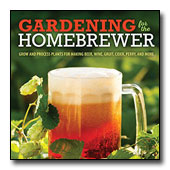
Gardening for the Homebrewer: Grow and Process Plants for Making Beer, Wine, Gruit, Cider, Perry, and More

By co-authors Debbie Teashon (Rainy Side Gardeners) and Wendy Tweton
Copyright Notice | Home | Search | Resources | Reference