
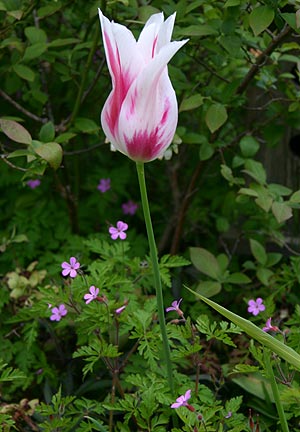
Stinky Bob — Geranium robertianum
A Note From the Author
The science of flora is a non-static accumulated knowledge. With that, I stand before my readers with my hat in humble hands. In the past I have mentioned, systemic herbicides—to the distress of the editors of this site—but a growing body of science has found that some products, in particular Monsanto’s Roundup, may be accumulating in numerous genetically engineered foods (75% or more are specifically modified to tolerate this systemic agent). The active ingredients ‘in combination’ may be more dangerous than the public has been led to believe. Human placental cells may be highly sensitive to glyphosates and is known to have an adverse effect on nontarget species, specifically amphibians. Monsanto Inc. has refuted these findings and stands by its claims that this product is a safe.
For further information on the current research see:
Biosafety Information Centre
Institute of Science in Society
Geranium species appear in many gardens as non-invasive colorful and hardy sprinkles of color, but numerous aggressive members of that family are rapidly encroaching under our collective noses, for example, stinky Bob or herb Robert (Geranium robertianum). This species coupled with dovefoot (G. molle), is overwhelming the roadside and open areas.
Identification
Geranium robertianum is easily confirmed by the “squish and sniff” method. Emitting a unmistakable pungent odor when crushed (hence the name stinky Bob), this ubiquitous menace can often be found lurking beneath other greenery within even the best tended gardens. Young plants exhibit the telltale lacy pattern of the mature leaf in miniature, though seldom forming the unbroken swaths commonly found with the Dovefoot species. The unique fringed reniform or kidney-shaped leaves identify stinky Bob.
Geraniums in toto are usually found in moist clearings, roadsides, and disturbed tracts. Some native geraniums are found either father north of our region or have flower petals greater than 12 mm in size. Couple these facts a leaf more resembling Pacific waterleaf, Hydrophyllum fendleri, and the chances of misidentification are slim for even the rankest amateurs.
G. bicknellii is a native that could be confused for non-native species but is usually found in the most northwestern reaches of our region. The afore mentioned native and the G. carolinianum may be locally common but both behave like weeds and should be removed from a tidy garden.
Erodium cicutarium, commonly called filaree, has a similar flower to geraniums and can be found in the same areas as geraniums, but it has a different leaf.
Removal
These species fall into the “tug and lug” category, though repeated attention may be required due to the persistent nature of the pointed seeds, resembling a stork or crane’s bill. Geranium translates to ‘crane’ in Greek.
These two geraniums, plus a half dozen lesser seen, invasive, non-native species, cast pointed seeds. This unique shape causes any movement—from wind, water, or animals—to force the tip deep into soil, allowing large numbers of seeds to exploit available water quickly and gain stability. The geranium species thus overwhelm nearby, less aggressive, species. This applies to native and non-native species.
Alternatives
Persistent gardeners can find G. oreganum the most pleasant and least aggressive of the geranium species. Containing a comparatively larger flower that is darker purple, it is more appealing than the G. richardsonii, with its paler pink or occasionally white petals, and the more aggressive G. carolinianum.
Wood sorrel, Oxalis oreganum, is an easy-to-grow alternative to the geraniums, though it requires more shade (less than four hours daily of direct sun).
A combination of Dicentra formosa, Achlys triphylla, Adenocaulon bicolor, and Cardamine pulcherrima var. pulcherrima (bleeding heart, vanilla leaf, pathfinder, and candy toothwort, respectively) can allow a conscientious native species gardener to find an equilibrium of natives within an area. Each species will adapt to a site where invasive geraniums are often found, but to varying degrees. If the site is towards the ‘sunny’ end of the spectrum, the toothwort and pathfinder will dominate. Conversely, the vanilla leaf and bleeding heart will muscle out the other two species if it tends towards the ‘shady’ side. All things being equal, these species can be used to determine these relatively subjective terms.
Wildlife Habitat
Geraniums are not per se food staples for large numbers of macroinvertebrates or larger fauna, but species like these provide cover for many creatures and often reduce the rates of evaporation. Any of the previously mentioned native species can be used to accomplish the same end.
Written by Mark N. McCann
All rights reserved.
Mark N. McCann is currently working on a book about Green Space and Stream Stewardship within the Vancouver-Seattle-Portland-Eugene (VSPE) Corridor. Based on his five years of experience removing invasive species, and replanting and propagating natives species within the Tryon Creek State Natural Area (TCSNA) as a member of the Adopt-A-Plot program. He has been a Citizen Member of the Tryon Creek Watershed Council, Friends of Tryon Creek and presently is a volunteer at Berry Botanic Garden, specifically in the Native Plant’s Trail and in the Propagation Department.
Photograph by Debbbie Teashon.
Co-author Debbie Teashon's book is now available!
Gardening for the Homebrewer: Grow and Process Plants for Making Beer, Wine, Gruit, Cider, Perry, and More

Copyright Notice | Home | Search | Pest Watch