April 2007

King County Weed News

Weed of the Month: Yellow Archangel (Lamiastrum galeobdolon)

Weed Tips for April

Volunteer for Earth Day Pulling Invasive Weeds

Upcoming Invasive Weed Workshops

Weed of the Month: Yellow Archangel (Lamiastrum galeobdolon),

Class C Non-Designated Noxious Weed

Yellow archangel
Weed of the month

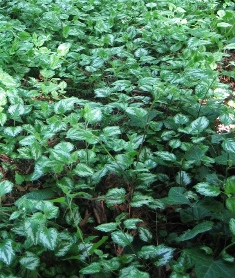
Our featured weed this month is becoming one of the plants I get the most questions about, either because it is causing a nuisance for someone or because it has mysteriously shown up someplace unexpected. I suspect it also gets lots of attention because of its distinctive leaves and its tendency to grow in dense, unbroken patches that call out for attention. The silver and green leaves and dense, sprawling growth are part of yellow archangel's attraction as an ornamental in shady beds or hanging baskets. Unfortunately, this is not a plant that stays where it is placed. Time and time again, yellow archangel has shown its ability to sneak away from a planting bed or discarded hanging basket and spread thickly into a nearby forest or ravine.

I have heard of and personally seen numerous examples of yellow archangel sprawling out of yard waste piles or flower beds and into the surrounding woodlands. The first time I saw yellow archangel was just this kind of situation. In the spring of 2000, a homeowner from the Ames Lake area asked for help identifying a plant that was spreading from a small pile of garden clippings she had left in the woods and taking over her forest. Sure enough it was yellow archangel. She had tried to pull it all up from a front garden bed, piled it up out back, and then returned later to find it growing out into the woods. Meanwhile, the area she had pulled was persistently coming back from small roots and stems left behind. I ran into the same homeowner last year and after about 6 years of hand-pulling most of the yellow archangel was gone, although there were still plants showing up occasionally.

This first homeowner's experience was enough to alert us to the potential invasiveness of this plant, but it did take several years of observations and gathering testimonials before it became clear that this was a candidate for noxious weed designation. For example, one homeowner east of Renton described how her native woodland flowers disappeared over a few years as yellow archangel took over in the forest near her house. What really concerned us was that yellow archangel was spreading into forests, not only urban and disturbed areas, but also high quality woodland areas with fairly intact native plant communities. Now that yellow archangel has been classified officially as a noxious weed in Washington State, our goal is to spread the word to gardeners everywhere to avoid introducing this plant near natural areas and to keep it contained where it is already growing. Also, it is our hope that infestations in natural areas will become a higher priority for removal by public agencies and land managers before they become too widespread to control. I was pleased to hear recently that the City of Kirkland will be using volunteers to remove the rather intimidating patch of archangel in their Watershed Park.

Yellow archangel goes by several other names. Its Latin name according to the USDA Plants Database is Lamiastrum galeobdolon, but you will also find it called Lamium galeobdolon or Galeobdolon luteum. Common names that it goes by include simply Lamium, golden dead-nettle, and, most interestingly, weasel-snout. The plants we see escape are all variegated although there is some disagreement about what exact species or variety this is or whether the non-variegated varieties of the same species would be invasive if they were given the opportunities that the silvery-leaved one has. It is best to avoid all varieties of the species, variegated or not, at least here in the Pacific Northwest, until we have more information.

For pictures and information about yellow archangel, there are several good resources on the internet, including the State Weed Board's Written Findings, Paul Graham’s web site on southwestern B.C. invasives, Arthur Lee Jacobson's website, and King County's yellow archangel web page and fact sheet on ID and control. The information available is still somewhat limited but fortunately Wendy DesCamp, a graduate student at the University of Washington, is researching this plant and will have more detailed information in the coming year or so. Also, I have heard that Tim Miller at WSU Extension will be starting some control trials soon in order to improve our technical information on how to control this plant.

If you have had any experiences with this plant, I am very interested in hearing about it, especially successes or problems with different control methods. Also, I am collecting locations of where this plant is growing un-invited, so please let us know about any locations you see in King County, especially if you notice it growing in an alarming way or in a remote natural area. Although control is not required for this non-designate noxious weed in King County, we are gathering information on distribution and impacts and would like to encourage people to remove it when it is threatening natural habitat. You can call us at 206-296-0290, send an E-mail or use our online infestation form .


Top


Weed Tips for April

Check pastures for toxic weeds. Animals will be more likely to graze poisonous plants if the grasses are still too short or sparse so check fields before setting animals out. Look for rosettes of tansy ragwort, milk thistle, and poison-hemlock and control them before letting the animals graze. For information on other poisonous pasture plants, contact your local extension office or conservation district. A handy summary of poisonous plants in western Washington can be found on our brochures page.

Watch out for giant hogweed in urban areas, parks, and anywhere else it has been spotted in the past. Check the noxious weed map for King County to see if it has been seen in your area. Hogweed’s large, jagged leaves and thick, purple-blotched stems should be tall enough to spot emerging above most other plants now and the plants will be easier to manage before they get full grown. Look for small seedlings and immature plants around the more obvious mature plants but be sure not to confuse non-native giant hogweed with similar native species cow parsnip and coltsfoot, also about the same size right now. Digging up hogweed this time of year isn’t too difficult, but be sure to use caution to avoid getting the sap on your skin because it can cause painful blisters and scarring. E-mail our program if you find this plant in a new location in the county.

April showers bring more than May flowers – disturbed areas in lawns, pastures, woods, and other places will fill in with seedlings of annual and biennial weeds like and bull thistle. Spreading perennials like Canada thistle and spotted knapweed will move in quickly as well. Walk trails, fields and yards to spot trouble areas that will need re-seeding or mulch to keep back weeds.

Catch weeds that are starting to flower. When a plant turns to flower production it’s a good sign that the roots are depleted and vulnerable. And waiting until seeds form will make it hard to control plants without spreading seeds. In late March, Scotch broom started to bud and will flower during April. Gorse was already flowering in most places by March and will continue through April. Keep your eyes out for the fragrant yellow flower clusters on large, spiny bushes. Expect to find gorse along coastal areas and in forests on well-drained soils. This is a good time to control both of these plants and the easiest time to find them. Also, Garlic mustard is up and will be flowering throughout April (some plants have already started to flower!), so check out likely places for returning plants and be sure to contact our program if you find any new populations of garlic mustard!

Control English ivy before the berries mature and while the soil is loose and soft. English ivy is easiest to find now before deciduous trees have fully leafed-out. Just be careful around storm-damaged trees – never pull ivy down from the upper parts of a tree since this might injure the tree and will most certainly injure you if branches fall off. Just pry the vines off the bark of the tree up to where you can comfortably reach and all the way down to the ground.

Top

Volunteer for Earth Day Pulling Invasive Weeds

This is a great time to pull weeds in parks – not too cold and not too hot, the soil is still nice and loose, and there are lots of events to choose from. Earth Day is on a Saturday this year – April 21 – so the timing is perfect. This is also a great way to meet people who are also really concerned about invasives and helping out our local natural areas! For a great Earth Day event with both fun and work, check out Earth Day with Duwamish Alive! sponsored by People for Puget Sound (and lots of other organizations and agencies). The City of Seattle has declared the whole month of April as Earth Month so check out Seattle’s 2007 Earth Month Events for lots of great activities. In Kirkland, check out the work parties at the Green Kirkland webpage (including two Earth Day events!). For volunteering in King County Parks, check out The Dirt: Calendar of Hands on Volunteer Activities. For volunteer events all along the Mountains to Sound Greenway, check out the Greenway Trust Volunteer Events Calendar. Two more great resources for volunteer events are EarthCorps’ Volunteer Calendar and Cascade Land Conservancy’s Events Calendar. For volunteering in your city, contact your local parks department for work parties – there’s always lots to do this time of year!


Top

Upcoming Invasive Weed Workshops

  • Ornamentals Gone Bad, May 19, 1pm-2pm, Furney's Nursery, 21215 Pacific Hwy S, Des Moines, WA 98198
  • Renton Weed Workshop, May 24, 6:30pm-8:00pm, Renton Senior Center, 211 Burnett Avenue N
  • Snoqualmie/North Bend Weed Workshop, June 5, 7pm-8:30pm, Meadowbrook Farm Interpretive Center, on Boalch Ave NW between Snoqualmie and North Bend
  • Seattle Backyard Invasives, June 21, 7pm-8:30pm, Northgate Community Center, 10510 5th Ave NE, Seattle, phone 206-386-4283 to register.
  • Burien Backyard Invasives, June 27, 6:30pm-8pm, Burien Community Center, 425 SW 144th St., Burien.
  • Lewis Creek Park Invasives Weed Walk and Talk, July 7, 1pm-3pm, Lewis Creek Park Interpretive Center, 5808 Lakemont Blvd, Bellevue

King County Water & Land Resources
All rights reserved.

Tell a friend about this page!


Top


Questions, comments or suggestions? Would you like to communicate with other Pacific Northwest gardeners? Please join us on our forum.

Back to Garden News Index